|
Hi,
If you’re in a rush, here’s what you need to know:
- Top AI experts are warning us that AI poses serious risks to public safety.
- I began fighting to set safety guardrails on AI three years ago, in 2023, after constituents came to me with concerns that the technology was advancing without guardrails.
- This week Bloomberg called my proposals a blueprint for federal action to protect the public from the risks posed by AI.
- We need the government to act quickly to get ahead of AI risks to prevent disasters instead of just reacting to them. We need to ensure AI benefits humanity — which it absolutely can do if done right — and prevents the harms we know are possible.
If you were alarmed by the recent warnings that rogue AI could soon kill all humans, you’re not alone.
Three years ago, I began to hear warnings like these from some of the top AI minds in the world (who also happen to be my constituents!). At community events and in meetings, more and more people began pulling me aside to give quiet warnings that AI could do enormous good — curing diseases, solving climate change, improving agriculture to bring down food costs — but also cause massive harm if left unchecked — particularly around cyber attacks on critical systems like the electric grid and banking system and weapons of mass destruction.
San Franciscans have a knack for being ahead of the curve, and I’ve learned to listen when they give warnings like this. Working with a grassroots group of researchers, youth activists, and safety experts, in 2023 I introduced the first bill in the nation to propose real safety regulations for AI.
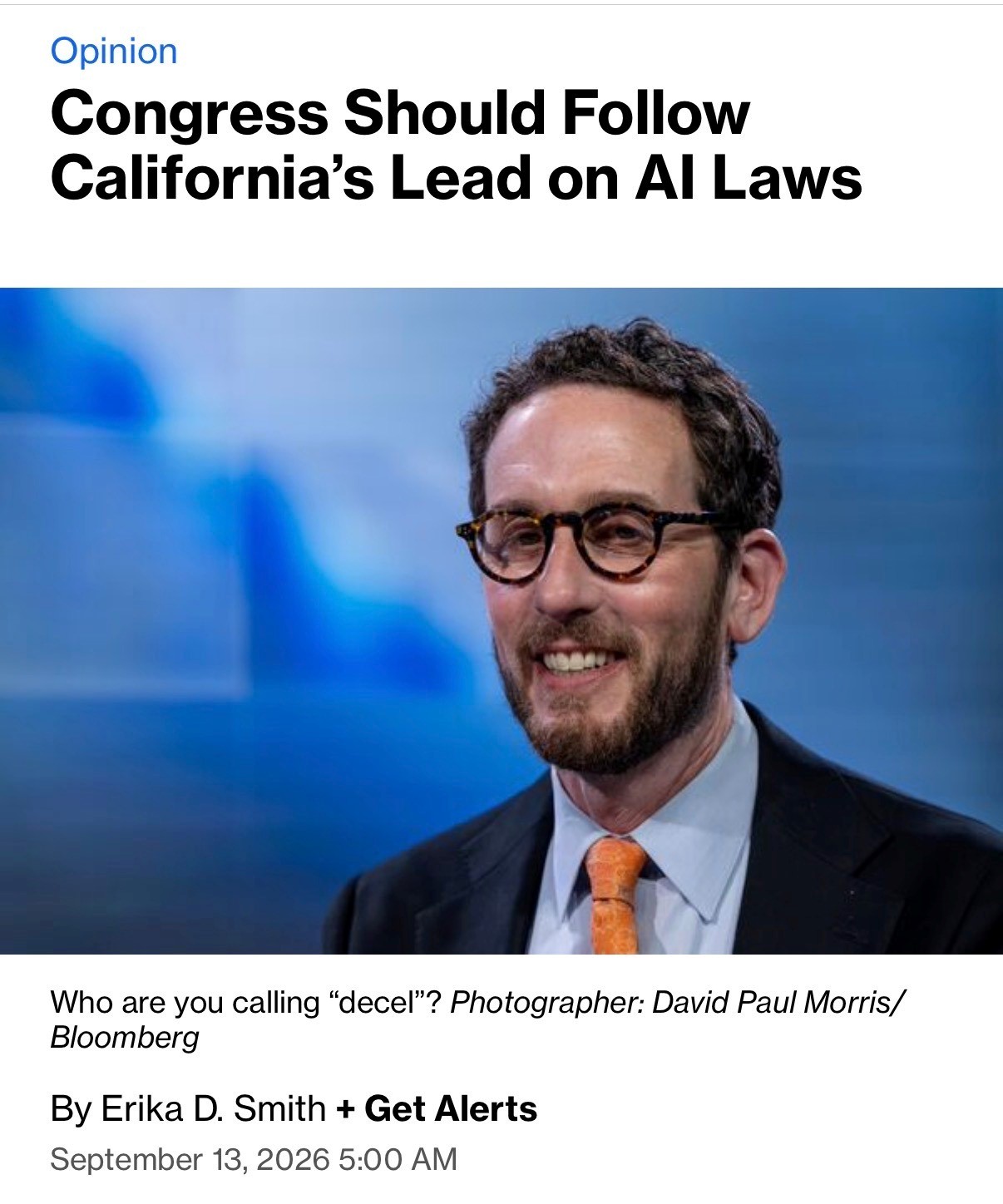
The AI industry didn’t like that very much. Bloomberg put it best in a column this week:
They called him a “doomer,” a “decel” and an “alarmist” who was too “focused on science fiction.” Turns out, Scott Wiener, the California state senator behind some of the country’s first safety regulations on artificial intelligence, was a Cassandra. All of a sudden, it appears he’s in good company.
He proposed mandating so-called “kill switches” to shut down AI models when they fall into the wrong hands or go rogue, like during the notorious Hugging Face incident. And more importantly, the bill would’ve ensured that AI companies could be held legally liable for harms caused by their advanced models. Both of these policies are now wisely being discussed at the federal level.
If Congress is serious, then its members should look to California. There are insights and ideas that can — and should — be gleaned from the state where many of the current policy discussions actually began.
We even called for requiring third-party verification that companies are following their safety protocols, an idea that Anthropic and OpenAI voluntarily agreed to over the weekend in the face of massive public pressure.
That bill was vetoed and never became law, but I was able to pass a law last year that drew from it to create an early warning system for AI safety by requiring companies to disclose their safety plans and dangerous AI incidents. That law has been replicated in 3 states.
Time and again, the work we do here in California becomes the blueprint for the nation.
And while I’m proud of the work we’ve done, there is so much left to do to protect the public from AI risks. AI is getting more powerful by the day, and we need to act quickly to get out ahead of its risks.
Whether at the state or federal level, we need strong safety standards for AI development backed by severe penalties for companies who break the rules. We need independent regulators to enforce those standards and update them as the technology evolves. We need kill switches. And we need to to back these laws up with real teeth.
I will keep fighting to make sure that our future is written by you and me, not by some pale AI imitation.
As always, please do not hesitate to reach out to my office with anything you may need. We are here to help. You can contact my office at (415) 557-1300 or through my office website.
Sincerely and in solidarity,

Scott Wiener
Senator
|